

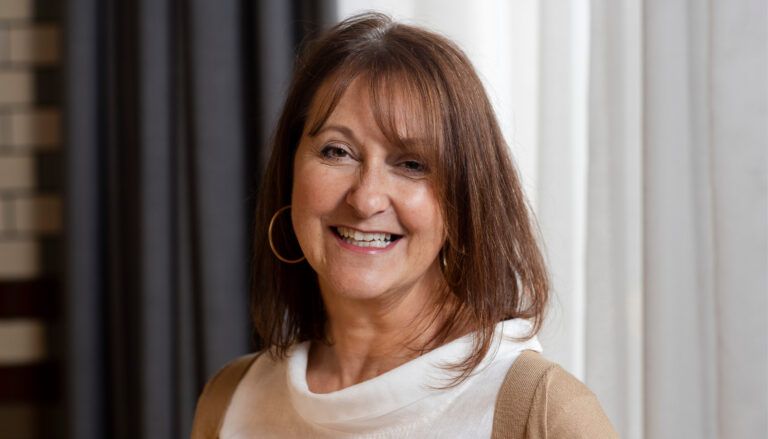
As executive director of Factory International, operator of the new Aviva Studios in Manchester, UK, Sheena Wrigley has played a crucial role in ensuring this new cultural hub, and the organisation itself, is true to its roots and the community it serves.
The UK city of Manchester, and its surrounding area, has a legendary music scene that has brought the world Joy Division, New Order, The Smiths, The Stone Roses, Oasis, The Fall, The Hollies, Herman’s Hermits, Happy Mondays, Elbow, Doves, Take That, Inspiral Carpets, and many, many more.
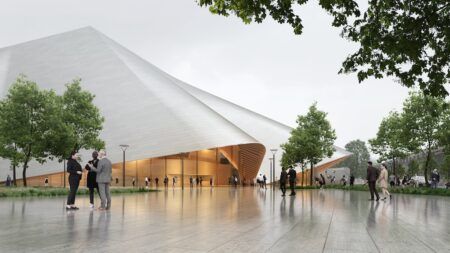
Now, part of the site of the city’s iconic former Granada Television Studios has been reborn as Aviva Studios, a bold new venue to serve the city and help incubate the next generation of artists across multiple disciplines. It officially opened in October 2023.
Sheena Wrigley is executive director at Factory International, which operates Aviva Studios and oversees the renowned Manchester International Festival (MIF). Factory International takes its name from the legendary Manchester record label that ceased trading in 1992, but far from engaging in nostalgia, it has a forward-thinking philosophy. Wrigley explains that the Studios project emerged from two key elements – MIF’s reputation for innovative artistic works, and Manchester’s successful strategy of anchoring urban regeneration around cultural institutions.

“Manchester International Festival has made a huge impact on the city, both culturally and from an economic perspective,” says Wrigley. “The question became: what would happen if it was possible to give the festival a home for year-round operation, and at the same time using an area of a city that hadn’t really been in the general public domain for quite a long time?”
Back to the old house
One site fitted the bill perfectly – the previous long-time home of Granada Television. Despite being in central Manchester, much of the site had been closed to the public for decades, creating interesting possibilities for development.
Aviva Studios has been designed to support a broad artistic programme spanning concerts, exhibitions and immersive experiences, while its public spaces host workshops, pop-up food stalls, music, markets and more.
The 13,350m2 (143,698ft2) building was designed by Office for Metropolitan Architecture (OMA), with Ellen van Loon as the lead architect. Manchester City Council led the development; Factory International handles operation and programming.
There are two versatile performance and exhibition spaces that can be configured in many ways. “Everything about the building is asking the question, ‘What do you want to do here? How could you use this space?’” says Wrigley.

Ten storey love song
The larger of the two main spaces, the Warehouse, is a cavernous rectangular hall, 21m (68.9ft) tall, that Wrigley compares in scale to the Tate Modern’s Turbine Hall in London. “You could stack four double-decker busses on top of each other in there, and it’s about the length of a jumbo jet,” she says.
This 2,565m2 (27,609ft2) space accommodates 5,000 people standing and can be divided into two using movable, full-height acoustic walls. A theatre grid spans the entirety of the area.
The other major performance space, the Hall, can accommodate 1,603 seated or 2,000 standing. It’s a more traditional proscenium-style auditorium, with a wealth of technical capabilities that belie its handsome wood-and-gold aesthetic. The proscenium is 22m (72ft) wide and there’s an orchestra pit for 80 musicians.

Atmosphere
“There’s an extraordinary surround-sound system in there, which enables us to do highly directional and engineered sounds,” says Wrigley. “You can have people speaking anywhere in the space, but sounding as if their voice is genuinely coming from them.”
This audio system can be utilised across all of Aviva Studio’s flexible spaces, allowing for sophisticated sonic configurations. Wrigley cites a recent collaboration with the BBC Philharmonic and composer Huang Ruo on a work entitled City of Floating Sounds, where the orchestra was separated into islands of sound, and the audience moved amongst them, but the way the sound was engineered enabled you to hear the full orchestra wherever you moved.
The interior design of the spaces balances raw industrial elements (reflecting the heritage of the site) and elegant, jewel-toned flourishes. Wrigley worked closely on space planning and equipment procurement with the architecture firm OMA and interior designer Ben Kelly.
Kelly is known for his work on Manchester’s legendary Haçienda club, and there’s little nods to that period in an overall vibrant design. “There’s a lot of contrast with the harshness of exposed concrete and bright pops of colour,” Wrigley says. “I think it makes the space feel just more playful and more fun, and hopefully it makes people feel more welcome.”

24-hour party people
This attention to hospitality and user experience extends beyond the performance spaces, with a wealth of flexible social spaces and bars throughout the building and its outside areas. “Everything moves,” Wrigley explains. “Nothing’s fixed in terms of furniture – we can move everything out the way. We use the social downstairs space as a performance space as well. We use it for parties, poetry and comedy nights. So that, in itself, is a performance space.
“It’s an extraordinarily vibrant, dynamic space, and I think the interior design has been very clever in that we’ve managed to get a real line from the architect and interior designers we’ve worked with, keeping everything as flexible and modular as possible.”
There is a light that never goes out
The project has created new physical walls for the organisation to operate behind, a challenge for the team that had previously engaged easily with the public thanks to MIF’s use of a variety of spaces around the city. “We’re really conscious that, having come behind walls, we’ve potentially created a new barrier,” says Wrigley. “When we were doing a piece of work in an old mill or in the middle of a street in Manchester, there was an erosion of barriers, because we weren’t in an arts building. We are now in an arts-style building, a building that’s very striking architecturally and could look a bit imposing.”
Wrigley and her team have met this challenge by ensuring that community engagement was central to the project’s mission from the outset, implementing initiatives including co-curation programmes and accessible pricing.
“We have what we call neighbourhood organisers, who are community advocates working across Manchester,” explains Wrigley. “About 32% of our ticket sales are what we call affordable tickets, meaning they’re either to people on low incomes, students, senior citizens or those who require access tickets.”

Look through any window
Factory International also has an eye on hyper-local engagement, running ‘Meet the Neighbours’ events aimed at those beginning to occupy the new residential and office buildings being constructed nearby.
Wrigley emphasises the importance of ensuring that the grand new venue feels truly welcoming and accessible to all. “We’re working doubly hard to make sure that people feel that it’s a place they can be,” she says. “We’re working hard to increase the diversity of our programme.”
Wrigley is particularly passionate about Aviva Studios’ role in the local community, seeing it as a catalyst for cohesion and engagement: “When you walk in here, across a space of a week, you’ll see unbelievably different groups of people that will find their way here and make it their own.”
Whether it’s sip-and-paint events, skate competitions or family workshops, Wrigley delights in seeing the diverse ways the public engage with the space. “It just moves between these different groups and communities,” she comments. “That’s just fabulously exciting.”

Something is happening
The MIF will continue to be staged in spaces across the city every other year, but with a permanent home there is more space and time to fill with new productions. “We’re not creating original work every single week here, but we do create sizeable amounts of original work that you won’t see anywhere else,” says Wrigley.
Strategic partnerships have been formed with a range of creative institutions, both locally and on the global stage, allowing Aviva Studios to produce work with all the hallmarks of the MIF, but that has a sense of scale befitting a national and even international level. “We’re beginning to partner, seek out, and be sought out by some really interesting partners,” says Wrigley.
One example is the David Hockney installation from London’s Lightroom, a project that can only be accommodated in the region in Aviva Studios’ expansive spaces. “We have enough technical specialism, equipment and knowledge that means we can do things that are hard – productions that are difficult for anywhere else to stage, particularly in the northern part of the UK,” says Wrigley.
She’s also looking to develop longer-term international collaborations, to cement Aviva Studios’ reputation. “We’ve got a number of really big international partners, who usually work with places of significant scale that there are probably only nine or 10 of globally.”
World in motion
Wrigley and her team have overseen not just the physical transformation of the site for Aviva Studios, but an organisational shift as well – going from the logistical team behind an arts festival to one with much wider, permanent responsibilities.
“We’ve transformed ourselves into Factory International as a kind of umbrella identity for all of the work that we do,” says Wrigley. “This includes running MIF still, but also operating the building, all our international work, and all our engagement and community work, too.”
This growth in scale and ambition has brought its own operational challenges. The organisation was built on informality. But now with more than 200 full- and part-time staff, more formal structures are required.

The masterplan
Wrigley is spearheading a “review and reset” process to shift the venue’s working practices. “We’re having to develop structures, protocols, ways of working, approaches to work, that have the DNA of who we are in them, but are more formal and more suited to a larger organisation, and that’s a difficult transition,” she says.
Looking to the future, Wrigley is excited but realistic about the challenges ahead. “Sustaining ourselves as an organisational entity, so people can still bring energy and positiveness to work, after such a period of change and transformation, is really important,” she says.
However, she remains confident in Aviva Studios’ ability to cement its place at the heart of Manchester’s cultural landscape, driven by a vision of the venue as a home for the city’s diverse communities. “We’re constantly inventing and then trying to evaluate whether our ideas worked,” says Wrigley.
It’s a sentiment that speaks to the very essence of Aviva Studios – a place of creativity, reinvention and community.
This feature was written by Tom Stone, and first published in November 2024 in the 2025 Annual Showcase issue of Auditoria.